To return to Wirral Sea Fishing, close down this window in the browser.
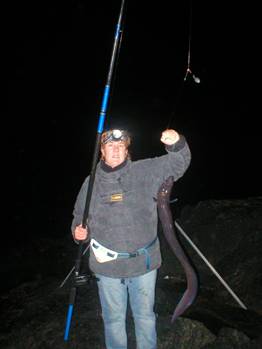
Few fish can stir the imagination of the sea angler as the conger eel. For some it is a species that invokes revulsion and fear and in others dedicated obsession. Most shore anglers’ encounters with this fish are when a small eel, often known as a ‘strap’, picks up a bait intended for other species. The battle that follows is often short lived as the fish either bites through the light snood or quickly finds sanctuary in a bottom snag. Even when targeting the eel, the fish generally has the advantage over the angler due to the rough nature of the ground being fished. However, this needs to be weighed against the fact that the conger eel can provide the angler with fights that stay etched on the memory, as few sea fish can match the conger for raw fighting power.
Conger eels are common around the coast of the UK. Deep water rock marks, piers, jetties and dock walls are all typical areas where the fish lives. There are two features that are typical for eel marks which are a combination of deep water and bottom structure such as large boulders that afford plenty of resting places for the eels during daylight. Certain marks are noted for producing big eels, particularly those of the River Tamar at Plymouth which currently holds the UK record of 68lb. However, bigger fish have been lost and a rumoured 100lb + fish was reported from Holyhead Breakwater.

With the deep water rock marks of Anglesey, quality conger fishing is within easy reach of the Merseyside shore angler. Marks such as Holyhead Breakwater, White Beach and the Menai Straits have all produced big conger eel to the shore angler. The Mersey itself contains a stocks of eels although these are rarely targeted. Noted marks for the species on the Mersey include, The Alex Wall, Seaforth Rocks, Perch Rock and the Mersey Ferry terminals at Seacombe and Woodside.
Approach
Before tackling the shore conger, the first item that the shore angler needs to be equipped with is patience. This requires the angler to take a different approach to his angling with a realistic target being one fish per session. Bites may be few and far between and even when a take occurs the angler still has an uphill battle before the fish is finally landed. A careful planned approach is also required as most of the fishing will be carried out from rock marks at night with the inherent dangers that presents. This is not a sport to be undertaken by the lone angler or at a mark that anglers are not familiar with. Before fishing, the method for landing the fish should always be considered.
Rods and Reels
Robust tackle is a requirement for shore conger fishing. Soft rods have no place for shore conger fishing as the first few moments of the fight are crucial to prevent the fish reaching a bottom snag. This is where a stiff beachcaster comes in to its own as it has the power to lift the fish clear from the bed during those important initial moments of contact. The rod also needs to be capable of casting large baits with lead, although distance casting is rarely required. Many of the rods sold for rough ground fishing are suitable for the task. Reels also need to be suitably robust with good line capacity and suitable models include Abu 7000 or Penn 535’s or Slosh 30s. The reel needs a good line capacity as the normal line for shore conger work is between 30 – 40lb. A good quality line should be loaded on to the reel with most conger specialists opting for Ultima Red Ice due to its good performance and visibility at night.
Terminal Tackle
The terminal tackle for shore conger fishing is simple but needs to be constructed from quality components. A simple running ledger is all that is required as no distance casting is needed and a free running rig is used to allow the conger to take line on the take. Due to the rough ground that is often fished for conger, a rotten-bottom of weak line is often incorporated. There are a range of commercially available systems available. Rottem bottoms can help reduce tackle losses and, more importantly, can also prevent the loss of fish. Conger eel marks are often characterised by low tidal flows and a 4 – 6oz plain lead is often sufficient to hold bottom and reduce the potential for snagging. If flows are present then grip leads may be used to prevent tackle being dragged into snags.

The angler should pay particular attention to the hook length. This needs to be a minimum of 100lb monofilament or wire of around 2 – 3 ft in length. This is required to resist the teeth of the conger. Both types of trace have there own benefits and disadvantages. Wire is susceptible to kinking which can weaken the trace. Kinked traces should be discarded and replaced. Monofilament traces of high breaking strains tend to coil although they can be straightened by hanging them with an attached weight for several days prior to fishing. A swivel and hook should be crimped to each end of the trace. Double crimps tend to be the most effective and extra security can be obtained for mono traces by melting the free end to a blob.
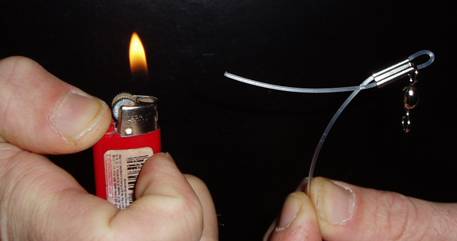
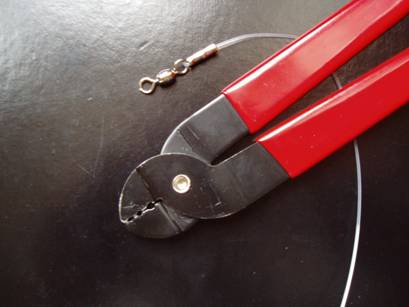
Details of basic crimping techniques can be found at http://www.leadertech.com/crimp_techniques.html . Good quality swivels of 80 –100lb b.s are also required as part of the trace, as conger will often rapidly spin at some point during a fight. This often occurs as the fish is near the shore and it is at this point that many fish are lost.
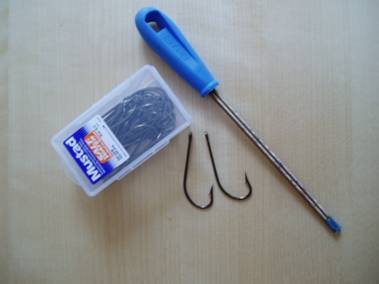
Large hooks, in the 6/0 to 10/0 size range, are required so that the point is clear of the large baits that are used. Stainless steel hooks should not be used as it is not always possible to unhook the fish, particularly if deeply hooked, and the trace will need to be cut. A bronzed hook will quickly disintegrate in seawater. The Mustard model 3406 provides an ideal hook but tends to require sharpening before use.
Other essential items
Good lighting is essential for rock fishing at night particularly given the difficulties that can be encountered when landing a large eel. There are two methods for landing an eel.
Small eels may be hand-lined up but gardening type gloves should be worn to prevent damage to hands from the line and leader. The other method is to gaff the fish through the lower jaw to reduce the damage to the fish. Gaffs should have a fixed head as screw-on type heads can become unwound from the struggles of the eel. Drop nets are of little use for conger fishing as it is very difficult to get an eel into a net. A range of unhooking equipment should be available that should include either long-nose pliers or a T-bar along with wire cutters to cut the trace or hook.
Bait
There are three main bait types for conger eel fishing:-
· Large fish baits
· Squid
· Cuttlefish
Mackerel, herring, pollack, whiting and pouting are all good baits for conger eels with freshly caught baits being preferred. These baits can be fished in a variety of ways from head sections, tail sections, flappers and large fillets. The key for baiting up is that plenty of hook point should be exposed.
Details on the method of preparing a mackerel flapper are available at http://www.britishcongerclub.org.uk/mackerel_flapper.htm
Fish heads and flapper baits are usually mounted on the trace by passing the hook through the mouth and up through the head.

Tail sections can be mounted on the trace either by passing the hook through the tough tail root or by threading the hook down through the bait. This is undertaken either with a baiting needle or by threading the hook down the bait. The method for threading a tail bait is shown below:-

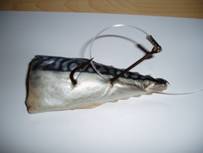

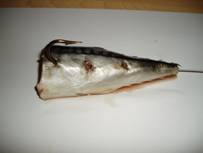
Threading a bait is best undertaken with a monofilament hook length as it can cause kinking in wire hook traces. Small whole fish baits can be mounted on the hook in a similar way with the hook exiting through the head or eye socket. Whole fish baits are often punctured with a knife to improve their scent trail in the water.
Squid and cuttlefish can be thread mounted as single baits or as double baits on a 6/0 Pennell rig. Cuttlefish are available from the freezer sections of Chinese Supermarkets. The baits can be secured with bait elastic if required to prevent them sliding down during casting and masking the hook point.
Timing and Tides
Conger eels are generally nocturnal in habit. On deep venues or where water is coloured, eels can be caught during daylight. However, the pursuit of conger is best undertaken at night.
Conger eels tend to be most active during small tides and slack tide periods. Neap tides should be targeted as the prime time for conger angling. Where tidal flows are present the peak of eel activity usually occurs during the slack water period around the turn of the tide at high or low water.
At deep water marks conger can be caught throughout the year although tend to become lethargic during prolonged cold spells. Generally the peak season for conger fishing from the shore is during the autumn months. Noted periods of peak eel activity are after a frost, a settled period after high winds or prior to an advancing storm. Conger eels tend to become more difficult to catch from most marks from December onwards.
Tactics – the conger session
You arrive at your chosen deep water rock mark 1 hour or so before dark, tackle up, settle in and decide upon a safe route for landing your fish. This gives you some time to try and catch some fresh bait, such as pollack or mackerel, on lures or feathers before nightfall. You have selected your visit to coincide with a neap tide and it is just on high water when you arrive. As darkness falls you cast out two baits, one double squid bait about 10 yards out (never ignore close in) and a mackerel head at about 40 yards. The drag on your reels is wound down tight (so that you can gain line through the important first moments of the fight) the line clicker switched on and the reel put into free spool. Now you settle down and wait.
Thirty minutes pass without activity so you re-cast with fresh baits and it gives you a chance to see how the baits are standing up to crab activity. Another 20 minutes pass with only the occasional rattle on the rod tip. Then you get a series of violent jerks on the rod tip and a reel lets out a yard or so of line. You pick up the rod and feel a tugging on the other end.
The most difficult part of shore conger fishing is knowing the best moment to strike. Too early and you can pull the bait away from the fish. If this happens let the bait fall back to the bottom as the eel will often give chase and pick it back up. Too late with the strike and the fish can take your tackle into a snag.
The gentle tugs on the line turn into slightly stronger pulls, you wind down on the reel until you feel the weight of the fish and make a firm strike. You wind the reel fast to quickly lift the fish away from the snags. The rod arches over and a small strap eel of around 5lb eventually hits the surface. This one can be hand-lined up, is quickly unhooked and returned.
All is quiet for the next 2 hours with only recasting fresh baits to interrupt the wait, and re-tackling after losing two sets of end tackle to bottom snags. The rod tip slowly bends and the reel emits three clicks. The larger eels will often give you much more gentle bites. You time your strike but fail to wind fast enough in the first moments of the fight and the fish finds sanctuary in a bottom snag. Eventually after trying various methods to see if the fish can be freed, such as slackening the line, all is lost.
Another hour passes and a similar gentle bite occurs. It is turning into a good night with three runs. This time your strike is well timed and your rod hoops over and a heavy thumping weight is felt. Slowly you gain line and the conger comes to the surface. You have got it to the rock edge, this fish will need the gaff. Your companion goes down to the water’s edge with the gaff and eventually, after the fish stops spinning, manages to secure the fish through the lower jaw. An eel of 14lb is carried up, the trace is cut as it is deeply hooked, the fish is then weighed, photographed and returned.

All the effort and preparation has been worthwhile and you have memories to last you for a long time. That is the last of the action for that night and the time will pass slowly until your next planned session.
Thanks to "Sqiud" for taking the time to prepare this feature for Wirral Sea Fishing